Last Updated: November 3, 2026
Quick Summary
Reformer pilates benefits for mobility by guiding you through controlled movement across a full range of motion, with spring resistance supporting your body the whole way. The reformer trains active mobility and strength together, so stiff joints get gentle, repeated practice, and beginners often notice easier movement with regular practice.
- Mobility is active joint control, while flexibility is passive muscle length; the reformer trains both at once.
- A beginner mobility routine takes about 35 minutes, starting with one to two springs for leg work.
- Keep leg circles small at first, roughly the size of a dinner plate, and slow the movement down.
- Track progress weekly with markers like seated reach, getting off the floor, and morning stiffness.
- Seek advice from a GP or physiotherapist first if you have persistent pain or a recent injury.
Table of Contents
- How Reformer Pilates Benefits for Mobility Work in Practice
- Reformer Pilates Exercises for Mobility: What You’ll Actually Do
- Pilates for Hip Mobility: Springs, Straps and Controlled Range
- Reformer Pilates for Beginners: A Practical Mobility Routine
- Pilates for Back Stiffness: Spinal Mobility and Posture
- Tracking Progress and Booking Your First Reformer Class
- Frequently Asked Questions
How Reformer Pilates Benefits for Mobility Work in Practice
Reformer Pilates benefits for mobility come down to one idea: controlled movement through a full range of motion, with spring resistance guiding you the whole way. Beginners often notice easier movement with regular practice. The reformer supports your body while you move, so stiff joints get gentle, repeated practice.
Mobility is the ability to move a joint actively through its range with control. Flexibility is the passive length of a muscle. You can be flexible and still have poor mobility. That gap is where most stiff backs and tight hips live.
Mobility Versus Flexibility: Why the Difference Matters
Mobility is active. It means your muscles and joints can take you through a movement on their own. Flexibility is passive length, like reaching toward your toes when gravity does the work.
The reformer trains both at once. Spring resistance builds muscle strength around joints while you move through a controlled range. That combination is why reformer work feels different from static stretching.
If you want the foundations first, our team explains the principles and benefits of Pilates in more detail.
Reformer Pilates Exercises for Mobility: What You’ll Actually Do
A typical mobility-focused reformer session uses a handful of movement patterns, repeated with control:
- Footwork on the footbar: builds ankle, knee and hip range while you press the carriage away
- Leg circles with straps: hip mobility with spring resistance
- Bridging: spinal mobility and core stability together
- Side-lying leg work: hip control and alignment
- Roll-downs: spinal mobility and posture awareness
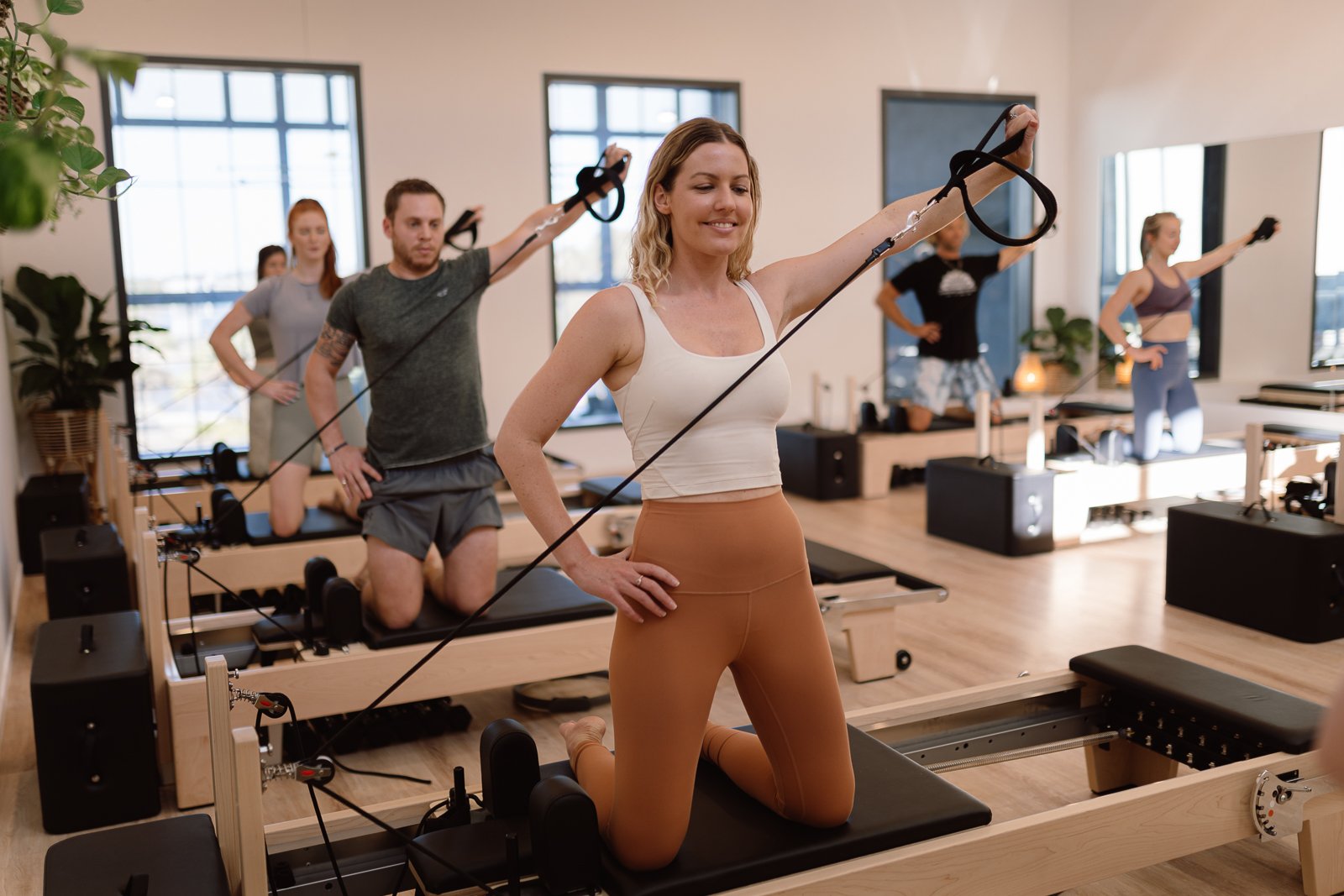
- Standing or kneeling arm work: shoulder mobility through a full range of motion
Each exercise asks for slow, controlled movement. The springs add resistance on the way out and support on the way back. That makes the reformer one of the safest places to train joint mobility, because you can dial the resistance up or down in seconds.
Pilates for Hip Mobility: Springs, Straps and Controlled Range
Hip mobility responds well to repeated, loaded movement. The reformer delivers exactly that. Straps hold your legs in positions you could not hold alone, so your hip joint moves through a bigger range without strain.
A common mistake is rushing the leg circle. Slow it down and you will feel the difference in your hip control within a few reps.
Reformer Pilates for Beginners: A Practical Mobility Routine
Total time: about 35 minutes. Level: beginner. Springs: start lighter than you think, most beginners use one to two springs for leg work and a single light spring for arm work.
- Footwork series (5 minutes): heels, toes, and arches on the footbar. Two sets of 10 slow presses per foot position. Inhale as you press the carriage away, exhale as you return. Keep the knees tracking over the middle toes.
- Bridging (5 minutes): two sets of 8 slow roll-ups, one vertebra at a time. Pause at the top for one breath. If your lower back feels compressed, reduce the range and stop before the hips fully lift.
- Leg circles (6 minutes): three circles each direction, each leg. Keep the circles small at first, roughly the size of a dinner plate. The strap should feel like a guide, not a tug-of-war.
- Side-lying leg work (6 minutes): two sets of 10 controlled lifts per leg. No swinging. If the hip hikes toward the ribs, reduce the range.
- Roll-downs (5 minutes): three slow roll-downs with a long exhale. This is spinal mobility and breathing practice, not a stretch to endure.
- Arm work with straps (5 minutes): two sets of 10 presses and 10 pull-backs. Keep the ribs anchored and the shoulders away from the ears.
- Cool-down breathing (3 minutes): slow, steady breath, four counts in and six counts out, to finish.
A common pattern is that beginners rush the leg circles and bridging because the springs make the movement feel easy. Slow it down and the mobility work actually lands.
Watch out: if you feel pinching in the front of the hip during leg circles, the range is too large or the spring is too light, shorten the circle and add a little resistance before continuing.
Adapting the Routine to Specific Limitations
- Stiff lower back: reduce the bridge range, skip roll-downs at first, and add a small pillow under the head if lying flat is uncomfortable.
- Tight hips: use a lighter spring and smaller leg circles, and spend an extra minute on side-lying work.
- Shoulder issues: keep arm work below shoulder height and reduce the strap tension.
- Difficulty getting on and off the reformer: ask for a lower carriage setting or a step stool, and start with seated footwork before moving to lying positions.
- Postnatal recovery: reduce spring load, avoid long holds on the back, and get clearance from your GP or a women’s health physiotherapist before returning to reformer work.
If you have a specific limitation, a physio-led assessment can map your starting point.
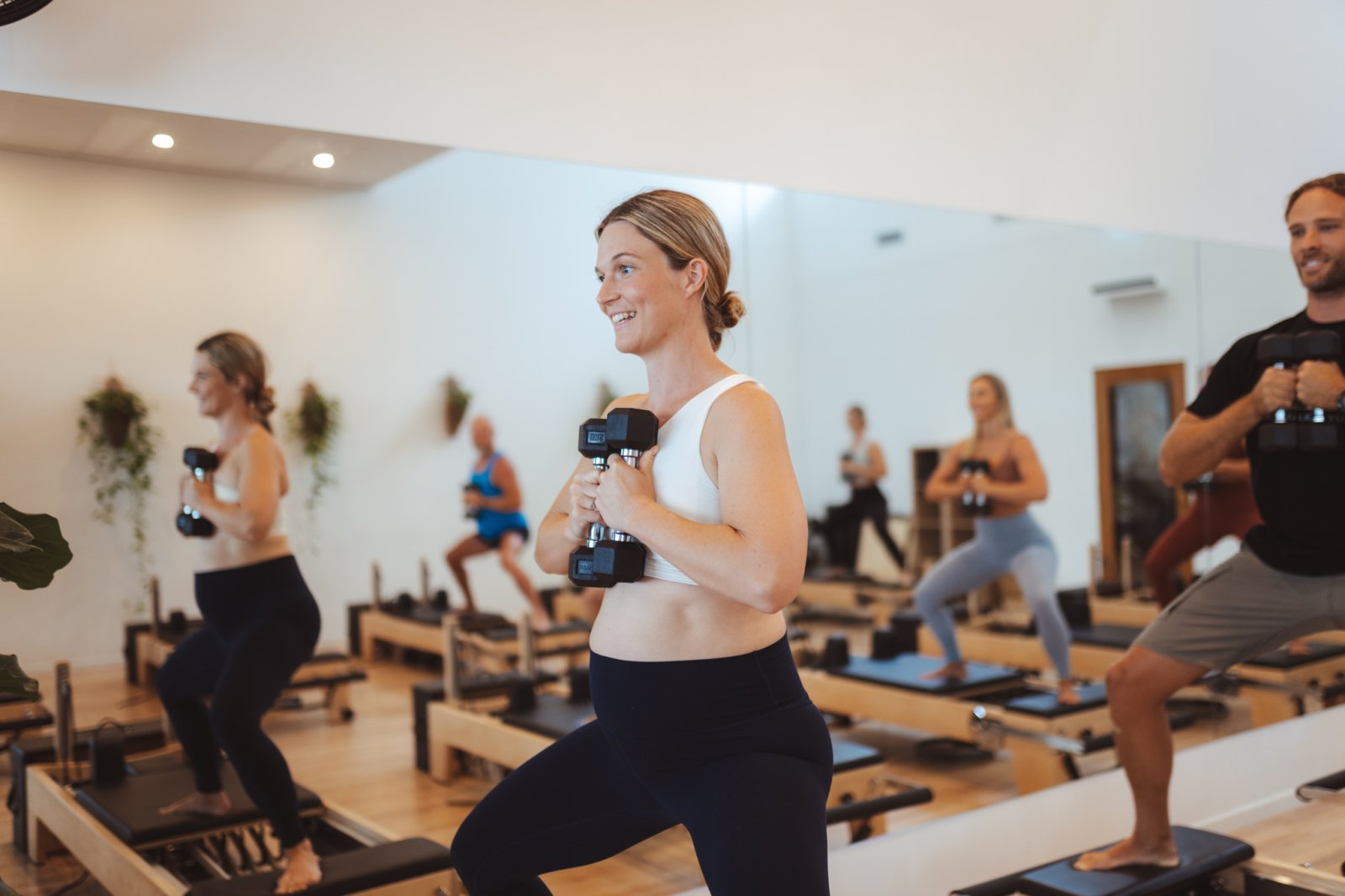
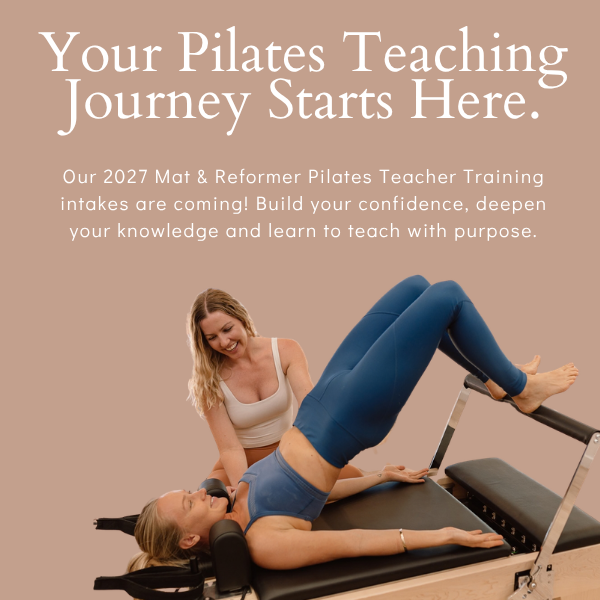
Instructor assisting a beginner with reformer pilates equipment in a bright, modern studio.
Here is the beginner mobility routine broken down by exercise, time and sets.
|
Exercise |
Time |
Sets and reps |
|---|---|---|
|
Footwork series |
5 minutes |
Two sets of 10 slow presses per foot position |
|
Bridging |
5 minutes |
Two sets of 8 slow roll-ups |
|
Leg circles |
6 minutes |
Three circles each direction, each leg |
|
Side-lying leg work |
6 minutes |
Two sets of 10 controlled lifts per leg |
|
Roll-downs |
5 minutes |
Three slow roll-downs with a long exhale |
|
Arm work with straps |
5 minutes |
Two sets of 10 presses and 10 pull-backs |
|
Cool-down breathing |
3 minutes |
Four counts in and six counts out |
Pilates for Back Stiffness: Spinal Mobility and Posture
Back stiffness usually eases when you move the spine in every direction, gently and often. The reformer lets you do that lying down, with support and control. Bridging and roll-downs train spinal mobility. Arm and leg work train posture and movement control.
Breathing matters here too. A slow exhale as you move helps you stay relaxed and keeps the movement smooth.
Tracking Progress and Booking Your First Reformer Class
Progress in mobility is easier to track if you measure the same things the same way each week. Pick a few markers and note them after each session:
- Reach: how far past your toes you can reach in a seated forward fold, measured in centimetres against a tape on the floor.
- Getting off the floor: how easily you can stand from sitting cross-legged, rated simply as easy, manageable or difficult.
- Morning stiffness: how your back feels in the first 10 minutes after waking, rated on a 1-5 scale.
A common pattern is that the first change is not a bigger reach but better control, the movement feels less wobbly before it feels longer. That is mobility improving, even if the tape measure has not moved.
Mobility Versus Flexibility: What Progress Actually Looks Like
Passive flexibility can improve in a few weeks of regular stretching. Active, usable mobility, the kind that lets you reach, squat and rotate under control, usually takes longer because it involves strength and coordination as well as length.
What the Evidence Does and Doesn’t Tell Us
Research on Pilates generally supports improvements in flexibility and functional movement for healthy adults, but studies often combine mat and reformer work, use small samples, and rely on short follow-up periods. Evidence specific to reformer-based training and mobility is thinner. That does not mean the benefits are not real, it means you should judge progress by how you move and feel, not by a headline claim.
When to Seek Professional Guidance
Seek advice from a GP, physiotherapist or qualified instructor before starting if you have:
- pain that persists beyond a few days or wakes you at night
- a recent injury, surgery or fracture
- diagnosed arthritis, osteoporosis or a joint condition
- balance problems or a history of falls
- pregnancy or postnatal recovery without clearance
A qualified instructor can also adjust springs, range and positioning so the session suits your body.
When you are ready, come and try it with us. You can explore our Reformer Pilates classes on our website to see how a session runs. New to the studio? An Intro Pass is an easy, low-commitment way to try Reformer Pilates for the first time.
Frequently Asked Questions
Is reformer Pilates good for mobility?
Yes. The reformer supports your body while spring resistance takes you through a fuller range of motion than you would manage unaided, which is why it suits stiff hips, shoulders and spines. You get strength and flexibility work in the same movement, with the carriage controlling the load.
How often should you do reformer Pilates to improve mobility?
Two sessions a week is a realistic starting point for mobility gains, with a day between classes so your tissues recover. One weekly class plus short daily mobility drills still helps, just more slowly. Consistency tends to matter more than intensity for range of motion.
What is the difference between flexibility and mobility in Pilates?
Flexibility is how far a muscle can lengthen passively. Mobility is your ability to move that joint actively through its full range with control and strength. Reformer Pilates can train both, with spring resistance and strap work building strength around joints. That is why mobility training focuses on joint control, alignment and body awareness, not just stretching further.
Can reformer Pilates help with back stiffness?
It can. For general stiffness, a beginner class with modifications is a sensible start. If you have persistent pain, a diagnosed disc or joint condition, or pain that travels down a leg, see a health professional such as a physiotherapist before starting, and let your instructor know so they can adapt exercises.
Ready to move more freely? At Morning Light Studio, our skilled teachers guide every level, our light-filled studio keeps sessions calm, and our inclusive community makes starting easy. Get started with Morning Light Studio and book your first Reformer class.